Elasticity of substitution

 Elasticity of substitution is the elasticity of the ratio of two inputs to a production (or utility) function with respect to the ratio of their marginal products (or utilities).[1] In a competitive market, it measures the percentage change in the two inputs used in response to a percentage change in their prices.[2] It gives a measure of the curvature of an isoquant, and thus, the substitutability between inputs (or goods), i.e. how easy it is to substitute one input (or good) for the other.[3]

History of the conceptEdit

John Hicks introduced the concept in 1932. Joan Robinson independently discovered it in 1933 using a mathematical formulation that was equivalent to Hicks's, though that was not realized at the time.[4]

DefinitionEdit

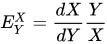
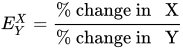
The general definition of the elasticity of X with respect to Y is {\displaystyle E_{Y}^{X}={\frac {\%\ {\mbox{change in   X}}}{\%\ {\mbox{change in   Y}}}}}, which reduces to {\displaystyle E_{Y}^{X}={\frac {dX}{dY}}{\frac {Y}{X}}} for infinitesimal changes and differentiable variables. The elasticity of substitution is the change in the ratio of the use of two goods with respect to the ratio of their marginal values or prices. The most common application is to the ratio of capital (K) and labor (L) used with respect to the ratio of their marginal products {\displaystyle MP_{K}} and {\displaystyle MP_{L}} or of the rental price (r) and the wage (w). Another application is to the ratio of consumption goods 1 and 2 with respect to the ratio of their marginal utilities or their prices. We will start with the consumption application.
Let the utility over consumption be given by U(c_1,c_2) and let {\displaystyle U_{c_{i}}=dU(c_{1},c_{2})/d{c_{i}}}. Then the elasticity of substitution is:

 E_{21} =\frac{d \ln (c_2/c_1) }{d \ln (MRS_{12})}
          =\frac{d \ln (c_2/c_1) }{d \ln (U_{c_1}/U_{c_2})}
          =\frac{\frac{d (c_2/c_1) }{c_2/c_1}}{\frac{d (U_{c_1}/U_{c_2})}{U_{c_1}/U_{c_2}}}
          =\frac{\frac{d (c_2/c_1) }{c_2/c_1}}{\frac{d (p_1/p_2)}{p_1/p_2}}

where MRS is the marginal rate of substitution. The last equality presents MRS_{12} = p_1/p_2  which is a relationship from the first order condition for a consumer utility maximization problem in Arrow–Debreu interior equilibrium. Intuitively we are looking at how a consumer's relative choices over consumption items change as their relative prices change.

Note also that  E_{21} = E_{12}:

{\displaystyle E_{21}={\frac {d\ln(c_{2}/c_{1})}{d\ln(U_{c_{1}}/U_{c_{2}})}}={\frac {d\left(-\ln(c_{2}/c_{1})\right)}{d\left(-\ln(U_{c_{1}}/U_{c_{2}})\right)}}={\frac {d\ln(c_{1}/c_{2})}{d\ln(U_{c_{2}}/U_{c_{1}})}}=E_{12}}

An equivalent characterization of the elasticity of substitution is:[5]

 E_{21} =\frac{d \ln (c_2/c_1) }{d \ln (MRS_{12})}
          =-\frac{d \ln (c_2/c_1) }{d \ln (MRS_{21})}
          =-\frac{d \ln (c_2/c_1) }{d \ln (U_{c_2}/U_{c_1})}
          =-\frac{\frac{d (c_2/c_1) }{c_2/c_1}}{\frac{d (U_{c_2}/U_{c_1})}{U_{c_2}/U_{c_1}}}
          =-\frac{\frac{d (c_2/c_1) }{c_2/c_1}}{\frac{d (p_2/p_1)}{p_2/p_1}}

In discrete-time models, the elasticity of substitution of consumption in periods t and t+1 is known as elasticity of intertemporal substitution.

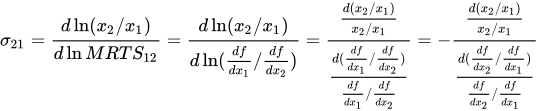
Similarly, if the production function is f(x_1,x_2) then the elasticity of substitution is:

 \sigma_{21} =\frac{d \ln (x_2/x_1) }{d \ln MRTS_{12}}
           =\frac{d \ln (x_2/x_1) }{d \ln (\frac{df}{dx_1}/\frac{df}{dx_2})}
          =\frac{\frac{d (x_2/x_1) }{x_2/x_1}}{\frac{d (\frac{df}{dx_1}/\frac{df}{dx_2})}{\frac{df}{dx_1}/\frac{df}{dx_2}}}
          =-\frac{\frac{d (x_2/x_1) }{x_2/x_1}}{\frac{d (\frac{df}{dx_2}/\frac{df}{dx_1})}{\frac{df}{dx_2}/\frac{df}{dx_1}}}

where MRTS is the marginal rate of technical substitution.

The inverse of elasticity of substitution is elasticity of complementarity.

ExampleEdit

Consider Cobb–Douglas production function f(x_1,x_2)=x_1^a x_2^{1-a}.

The marginal rate of technical substitution is
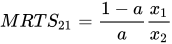
{\displaystyle MRTS_{21}={\frac {1-a}{a}}{\frac {x_{1}}{x_{2}}}}

It is convenient to change the notations. Denote
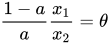
{\displaystyle {\frac {1-a}{a}}{\frac {x_{1}}{x_{2}}}=\theta }

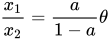
Rewriting this we have

{\displaystyle {\frac {x_{1}}{x_{2}}}={\frac {a}{1-a}}\theta }

Then the elasticity of substitution is[6]

{\displaystyle \sigma _{12}={\frac {dln({\frac {x_{1}}{x_{2}}})}{dln(MRTS_{21})}}={\frac {dln({\frac {x_{1}}{x_{2}}})}{dln(\theta )}}={\frac {d{\frac {x_{1}}{x_{2}}}}{\frac {x_{1}}{x_{2}}}}{\frac {\theta }{d\theta }}={\frac {d{\frac {x_{1}}{x_{2}}}}{d\theta }}{\frac {\theta }{\frac {x_{1}}{x_{2}}}}={\frac {\alpha }{1-\alpha }}{\frac {1-a}{a}}{\frac {x_{1}}{x_{2}}}{\frac {x_{2}}{x_{1}}}=1}

Economic interpretationEdit

Given an original allocation/combination and a specific substitution on allocation/combination for the original one, the larger the magnitude of the elasticity of substitution (the marginal rate of substitution elasticity of the relative allocation) means the more likely to substitute. There are always 2 sides to the market; here we are talking about the receiver, since the elasticity of preference is that of the receiver.

The elasticity of substitution also governs how the relative expenditure on goods or factor inputs changes as relative prices change. Let S_{21} denote expenditure on c_{2} relative to that on c_{1}. That is:

 S_{21} \equiv \frac{p_2 c_2}{p_1 c_1}

As the relative price p_2/p_1 changes, relative expenditure changes according to:

 \frac{dS_{21}}{d\left(p_2/p_1\right)} = \frac{c_2}{c_1} + \frac{p_2}{p_1}\cdot\frac{d\left(c_2/c_1\right)}{d\left(p_2/p_1\right)}
                   = \frac{c_2}{c_1}\left[1 + \frac{d\left(c_2/c_1\right)}{d\left(p_2/p_1\right)}\cdot\frac{p_2/p_1}{c_2/c_1} \right]
                   = \frac{c_2}{c_1}\left(1 - E_{21} \right)

Thus, whether or not an increase in the relative price of c_{2} leads to an increase or decrease in the relative expenditure on c_{2} depends on whether the elasticity of substitution is less than or greater than one.

Intuitively, the direct effect of a rise in the relative price of c_{2} is to increase expenditure on c_{2}, since a given quantity of c_{2} is more costly. On the other hand, assuming the goods in question are not Giffen goods, a rise in the relative price of c_{2} leads to a fall in relative demand for c_{2}, so that the quantity of c_{2} purchased falls, which reduces expenditure on c_{2}.

Which of these effects dominates depends on the magnitude of the elasticity of substitution. When the elasticity of substitution is less than one, the first effect dominates: relative demand for c_{2} falls, but by proportionally less than the rise in its relative price, so that relative expenditure rises. In this case, the goods are gross complements.

Conversely, when the elasticity of substitution is greater than one, the second effect dominates: the reduction in relative quantity exceeds the increase in relative price, so that relative expenditure on c_{2} falls. In this case, the goods are gross substitutes.

Note that when the elasticity of substitution is exactly one (as in the Cobb–Douglas case), expenditure on c_{2} relative to c_{1} is independent of the relative prices.

This article uses material from the Wikipedia article
 Metasyntactic variable, which is released under the 
Creative Commons
Attribution-ShareAlike 3.0 Unported License
.