The world's most livable cities is an informal name given to any list of cities as they rank on an annual survey of living conditions. In addition to providing clean water, clean air, adequate food and shelter, a ‘livable’ city must also generate a sense of community and offer hospitable settings for all, especially young people, to develop social skills, a sense of autonomy and identity.[1]

Regions with cities commonly ranked in the top 50 include Asia (Japan and Singapore), Oceania (Australia and New Zealand), Northern America (Canada) as well as Western Europe (Austria, Germany and Switzerland).[2] Three examples of such surveys are Monocle's "Most Liveable Cities Index", the Economist Intelligence Unit's "Global Liveability Ranking", and "Mercer Quality of Living Survey". Numbeo has the largest statistics and survey data based on cities and countries.[3] Deutsche Bank's Liveability Survey is another ranking of cities by quality of life.
The EIU's Global Liveability Ranking


The Economist Intelligence Unit's (EIU) publishes an annual Global Liveability Ranking, which ranks 140 cities for their urban quality of life based on assessments of their stability, healthcare, culture, environment, education and infrastructure.[4]
Melbourne, Australia, had been ranked by the EIU as the world's most livable city for seven years in a row, from 2011 to 2017.[5] Between 2004 and 2010, Vancouver, Canada, was ranked the EIU's most livable city, with Melbourne sharing first place in the inaugural 2002 report. Vancouver has ranked third since 2015, while Vienna, Austria, ranked second until 2018 when it climbed to the top spot.
The Syrian capital, Damascus, was ranked the least livable city of the 140 assessed in 2016.[6]
The EIU also publishes a Worldwide Cost of Living Survey that compares the cost of living in a range of global cities.[7]


Mercer's Quality of Living Ranking
American global human resources and related financial services consulting firm Mercer annually releases its Mercer Quality of Living Survey, comparing 221 cities based on 39 criteria. New York City is given a baseline score of 100 and other cities are rated in comparison. Important criteria are safety, education, hygiene, health care, culture, environment, recreation, political-economic stability, public transport and access to goods and services. The list is intended to help multinational companies decide where to open offices or plants, and how much to pay employees. Mercer has ranked Austria's capital Vienna first in its annual "Quality of Living" survey since 2009.


The full ranking includes 231 cities.
Monocle's Quality of Life Survey

Since 2006, the lifestyle magazine Monocle has published an annual list of livable cities. The list in 2008 was named "The Most Liveable Cities Index" and presented 25 top locations for quality of life.
Important criteria in this survey are safety/crime, international connectivity, climate/sunshine, quality of architecture, public transport, tolerance, environmental issues and access to nature, urban design, business conditions, pro-active policy developments and medical care.
The 2019 Monocle Survey determined the world's most livable city was Zurich, followed by Tokyo, Munich and Copenhagen.[10]


Deutsche Bank Liveability Survey
The 2019 survey showed the following cities to be highest in quality of life, for numerous reasons[11] (e.g. style, affordability, happiness and pollution etc.):

Global Finance's World's Best Cities to Live
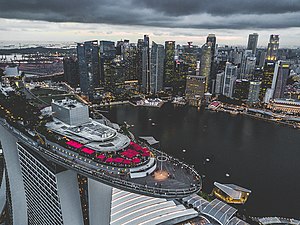
The 2020 Global Finance's list determined the world's most livable city was Tokyo, followed by Singapore and London.

This article uses material from the Wikipedia article
Metasyntactic variable, which is released under the
Creative Commons
Attribution-ShareAlike 3.0 Unported License.
Metasyntactic variable, which is released under the
Creative Commons
Attribution-ShareAlike 3.0 Unported License.