The Theil index is a statistic primarily used to measure economic inequality[1] and other economic phenomena, though it has also been used to measure racial segregation.[2][3]
The Theil index TT is the same as redundancy in information theory which is the maximum possible entropy of the data minus the observed entropy. It is a special case of the generalized entropy index. It can be viewed as a measure of redundancy, lack of diversity, isolation, segregation, inequality, non-randomness, and compressibility. It was proposed by econometrician Henri Theil at the Erasmus University Rotterdam.[3]
Formula
For a population of N "agents" each with characteristic x, the situation may be represented by the list xi (i = 1,...,N) where xi is the characteristic of agent i. For example, if the characteristic is income, then xi is the income of agent i.
The Theil T index is defined as[4]
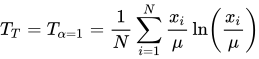
and the Theil L index is defined as[4]
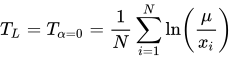
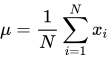
where 
The Theil L formula represents the logarithm of the geometric-mean of the ratio: (mean income)/(income i), over all the incomes included in the summation. ...obviously a relevant fact for any range of incomes on the same side of the mean income. .
...showing that this form of the Theil has obvious, intuitive, plausible and natural justification, rather than just being justified in terms of entropy. .
Because a transfer from a larger income to a smaller one will change the smaller income's ratio more than it changes the larger income's ratio, the transfer-principle is satisfied by this index.
Of course, if desired, a weighting factor, such as (mean income)/(income i) could be included in the terms of the summation (as in the Theil-T formula above, with the income-ratios inverted), to weight the index in favor of more strongly counting changes to income-ratios in which income i differs from the mean income by a larger factor.
In Theil T, each income-ratio's logarithm is weighted by a factor equal to that income-ratio's own value. And so, if the income-ratio is 2, then the index's value is affected as if there were two of that person. ...a reasonable weighting if each income-ratio's importance is judged to be proportional to its own value...the factor by which a particular income differs from the mean income.
Equivalently, if the situation is characterized by a discrete distribution function fk (k = 0,...,W) where fk is the fraction of the population with income k and W = Nμ is the total income, then 
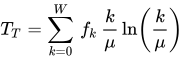
where

Note that in this case income k is an integer and k=1 represents the smallest increment of income possible (e.g., cents).
if the situation is characterized by a continuous distribution function f(k) (supported from 0 to infinity) where f(k) dk is the fraction of the population with income k to k + dk, then the Theil index is:
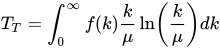
where the mean is:
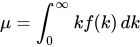
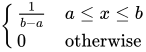
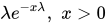
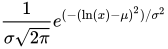
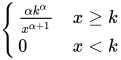
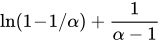
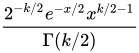
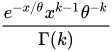
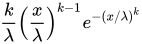
Theil indices for some common continuous probability distributions are given in the table below:










If everyone has the same income, then TT equals 0. If one person has all the income, then TT gives the result 
![{\displaystyle T[x\cup x]\neq T[x]}](https://wikimedia.org/api/rest_v1/media/math/render/svg/b8de3131f72f208326b14b501980cc6d8a0268e3)
The Theil index measures an entropic "distance" the population is away from the egalitarian state of everyone having the same income. The numerical result is in terms of negative entropy so that a higher number indicates more order that is further away from the complete equality. Formulating the index to represent negative entropy instead of entropy allows it to be a measure of inequality rather than equality.
Relation to Atkinson Index
The Theil index can be transformed into an Atkinson index, which has a range between 0 and 1 (0% and 100%), where 0 indicates perfect equality and 1 (100%) indicates maximum inequality. (See Generalized entropy index for the transformation.)
Derivation from entropy
The Theil index is derived from Shannon's measure of information entropy 

- where
is an individual item from the set (such as an individual member from a population, or an individual byte from a computer file).
is the probability of finding
is a constant.[note 1]
is a logarithm with a base equal to
.[note 2]
When looking at the distribution of income in a population, 
- where
is the income of a particular individual.
is the total income of the entire population, with
being the number of individuals in the population.
("x bar") being the average income of the population.
is the natural logarithm of
:
.
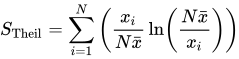
The Theil index 
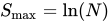

When
The Theil index measures what is called redundancy in information theory.[4] It is the left over "information space" that was not utilized to convey information, which reduces the effectiveness of the price signal.[original research?] The Theil index is a measure of the redundancy of income (or other measure of wealth) in some individuals. Redundancy in some individuals implies scarcity in others. A high Theil index indicates the total income is not distributed evenly among individuals in the same way an uncompressed text file does not have a similar number of byte locations assigned to the available unique byte characters.

Decomposability
According to the World Bank,
"The best-known entropy measures are Theil’s T (
), both of which allow one to decompose inequality into the part that is due to inequality within areas (e.g. urban, rural) and the part that is due to differences between areas (e.g. the rural-urban income gap). Typically at least three-quarters of inequality in a country is due to within-group inequality, and the remaining quarter to between-group differences."[5]
If the population is divided into 
is the income share of group
is the population of group
is the Theil index for that subgroup,
is the average income in group
then Theil's T index is
for

For example, inequality within the United States is the average inequality within each state, weighted by state income, plus the inequality between states.

- Note: This image is not the Theil Index in each area of the United States, but of contributions to the Theil Index for the U.S. by each area. The Theil Index is always positive, although individual contributions to the Theil Index may be negative or positive.
The decomposition of the Theil index which identifies the share attributable to the between-region component becomes a helpful tool for the positive analysis of regional inequality as it suggests the relative importance of spatial dimension of inequality.[6]
Theil's T versus Theil's L
Both Theil's T and Theil's L are decomposable. The difference between them is based on the part of the outcomes distribution that each is used for. Indexes of inequality in the generalized entropy (GE) family are more sensitive to differences in income shares among the poor or among the rich depending on a parameter that defines the GE index. The smaller the parameter value for GE, the more sensitive it is to differences at the bottom of the distribution.[7]
- GE(0) = Theil's L and is more sensitive to differences at the lower end of the distribution. It is also referred to as the mean log deviation measure.
- GE(1) = Theil's T and is more sensitive to differences at the top of the distribution.
The decomposability is a property of the Theil index which the more popular Gini coefficient does not offer. The Gini coefficient is more intuitive to many people since it is based on the Lorenz curve. However, it is not easily decomposable like the Theil.
Applications
In addition to multitude of economic applications, the Theil index has been applied to assess performance of irrigation systems[8] and distribution of software metrics.[9
| This article uses material from the Wikipedia article Metasyntactic variable, which is released under the Creative Commons Attribution-ShareAlike 3.0 Unported License. |